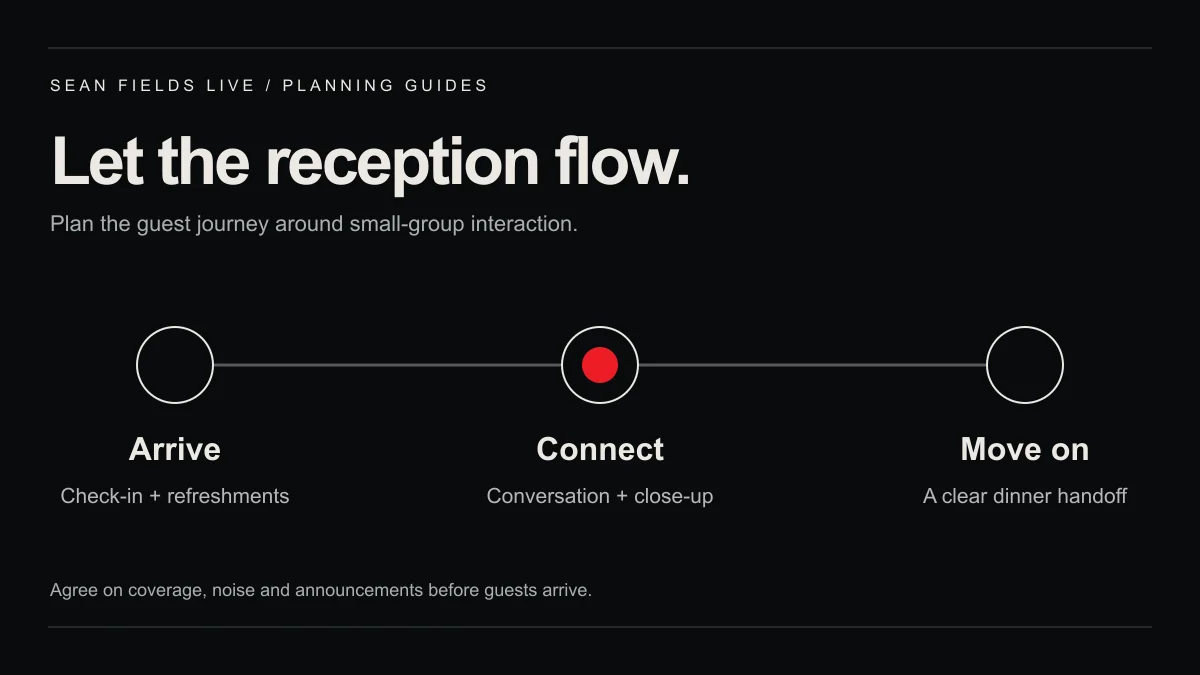
Close-up magic can sit inside a reception’s social flow, giving small groups a shared moment without stopping the whole event. Plan where guests gather, when they arrive and what happens next. Agree on coverage and interruptions rather than assuming every guest will see the same performance.
Give the reception entertainment a specific purpose
A cocktail reception often serves several jobs at once: welcoming guests, introducing colleagues or clients, allowing conversation and moving people toward the next part of the program. Entertainment should fit those jobs rather than make them harder.
When considering close-up magic for Winnipeg corporate events, explain whether you want an arrival-period conversation point, interaction among established groups or a bridge into a later shared show. Those are different briefs even when the guest count is the same.
Sean Fields offers close-up encounters as well as featured and hybrid experiences. Start with the shape of your reception and ask what coverage makes sense; do not treat a roaming format as unlimited entertainment wherever guests happen to be.
Map the room as a guest would move through it
Identify three zones on the floorplan: arrival and service points, places for conversation, and the route into the next activity. This simple map helps you describe where interaction could fit and where it could create an obstruction.
| Reception zone | What guests are doing | Planning question |
|---|---|---|
| Entrance, registration and coat check | Arriving, checking details and finding their bearings | Where can guests settle before an interaction begins? |
| Bar and food stations | Queuing, ordering and collecting refreshments | Can groups watch without blocking service or access? |
| Conversation areas | Talking, meeting people and staying for a few minutes | Is there space and manageable noise for small-group interaction? |
| Move into dinner or a session | Finishing conversations and changing rooms | Who signals the transition and when should interaction finish? |
The map is a discussion tool, not a direction to place a performer beside the busiest queue. Keep access and service routes clear and let the venue and performer assess the actual arrangement.
Agree on coverage, not an assumed show for every person
Guests may arrive over time, join different groups and leave for another activity. Tell the performer about that pattern as well as the total attendance estimate. A steady gathering in one room differs from several simultaneous rooms or a reception with continuous turnover.
Ask how the proposed coverage period relates to the audience and layout. Clarify whether the brief is to circulate among available groups or provide a particular agreed experience. Avoid announcing that everyone will see the same routine unless that has actually been planned.
If a shared moment for the entire audience matters more than circulation, consider whether a featured show belongs later in the program. The close-up versus stage comparison explains that distinction.
Let networking remain networking
At a client reception, some conversations may be time-sensitive or private. Brief the performer on the event’s purpose and any practical boundaries; do not assume every group needs to be interrupted simply because entertainment is available.
Hosts can help by giving clear introductions and explaining how the reception will flow. They do not need to script interactions or assign a reluctant guest to become the centre of attention.
Discuss participation concerns ahead of time. Sean’s published approach is respectful involvement without making a guest the punchline. The audience participation guide gives organizers useful questions about invitations and guest comfort.
Coordinate music, announcements and service
A reception does not need to become silent, but competing sound and sudden announcements affect the experience. Share the music plan, any speeches and whether another event will be audible nearby.
Give one organizer responsibility for communicating changes. If the welcome remarks move earlier, the performer needs enough notice to finish an interaction rather than be cut off by a microphone announcement.
The same applies to venue staff calling guests into dinner or opening a buffet. Include those transitions in the brief instead of treating them as separate from the entertainment plan.
Design the end of the reception as carefully as the start
Choose who signals the move, which room guests enter next and when the entertainment block ends. If a hybrid includes a featured show later, confirm the gap, setup and any change of room in the proposal.
A hypothetical reception brief might read: “Guests arrive in one lounge before a seated dinner in another room. We want small-group interaction once people have settled, with a clear finish before the host invites them to their tables.” Add the actual attendance, times and venue details.
Use the show-scheduling guide to connect the reception to the full running order. Before requesting a quote, include the format, coverage period and travel details described in the quote-scope guide.
A few more useful answers.
Does close-up magic require the whole reception to stop?
It is generally planned around small-group interaction rather than one shared feature. Confirm the proposed approach and coordinate any announcements or transitions that interrupt the reception.
Can guests arrive at different times?
Share the expected arrival pattern when discussing coverage. Continuous arrivals, multiple rooms and early departures can change what is practical within the agreed period.
Will every guest see exactly the same performance?
Do not assume that they will. Ask about coverage and expectations for the actual attendance, room and schedule. A shared feature is a different format.
Can reception magic be followed by a stage show?
A hybrid can combine both. Confirm the two blocks, the gap between them, any room change and the full scope in the proposal.
Sean Fields
Sean Fields is a Winnipeg-born magician, mentalist, magic creator and consultant with more than two decades of experience. His work spans close-up magic, corporate stages and creative consulting for television productions. These guides help organizers plan the setting, timing and guest experience for live entertainment.
More about Sean Fields