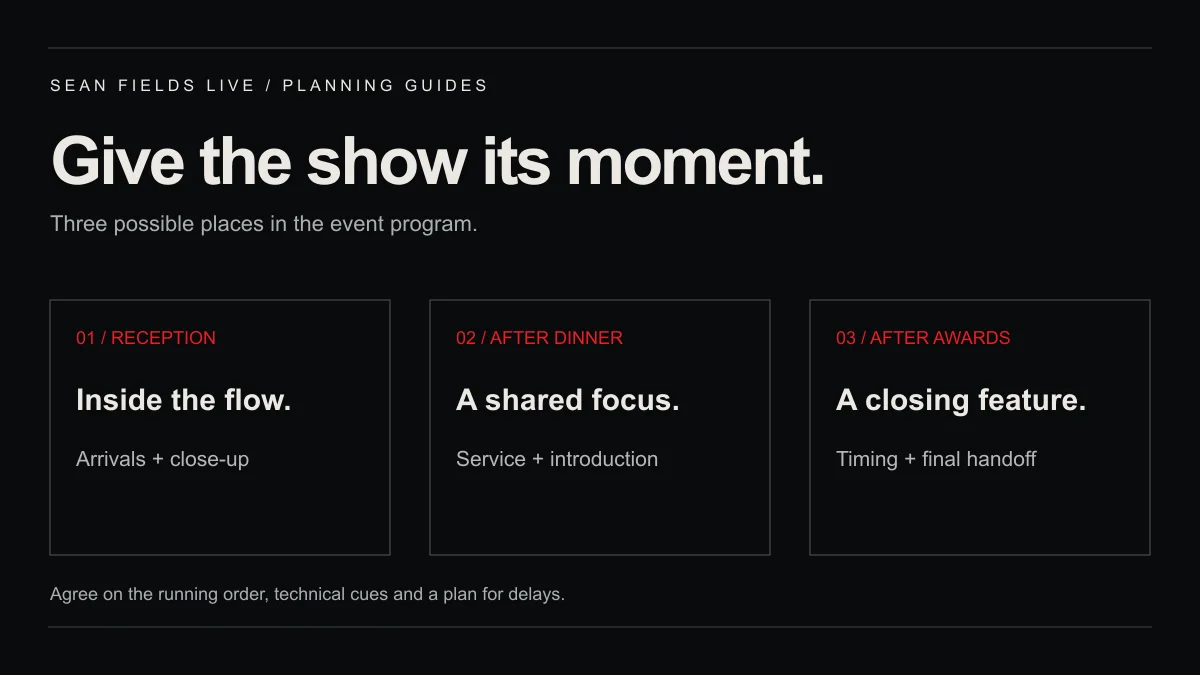
Place close-up interaction where guests are socializing and a shared feature where the room can focus. Coordinate dinner service, speeches, awards and technical cues before confirming the slot. There is no single correct running order; agree on one that suits your event and who can adjust it on the day.
Schedule for attention, not just an empty time slot
A gap in the running order is not automatically a good place for a show. Guests may be arriving, food may be coming out or the host may be about to begin an important announcement.
When planning Winnipeg corporate entertainment, decide what the performance should contribute to the evening. A reception interaction, a shared after-dinner feature and a hybrid serve different purposes.
Sean’s corporate page describes a typical 30–45 minute interactive stage experience alongside close-up and hybrid options. Confirm the actual duration and setup for your event before assigning a slot that cannot accommodate them.
During arrivals: interaction inside the social time
Close-up magic can fit a reception where people are circulating and meeting one another. It creates moments within the social flow rather than asking the entire room to stop at once.
Give the performer the real arrival pattern, not only the time printed on the invitation. Guests gathering at a bar, checking coats, taking photos or moving into dinner may affect how interaction is planned.
Also identify announcements and music changes. A welcome speech in the middle of an interaction needs coordination. The format comparison explains why reception coverage and a shared feature should be planned differently.
After dinner: give the shared feature a clean start
A seated audience can provide a natural transition into a shared performance, but meal timing needs agreement. Ask when service and clearing will happen, whether guests need to turn their chairs and who will introduce the feature.
Do not assume that the scheduled end of dinner means the room is ready. Service may still be active, guests may be moving and the host may need a moment to bring attention back together.
Discuss whether any service can continue without distracting from the experience. The venue and performer should agree on the workable arrangement rather than discovering competing priorities once the show begins.
Before or after speeches and awards?
Choose the order around the purpose of the program. If a major award or recognition moment is the centrepiece, protect the attention it needs. If the entertainment is intended to close the formal evening, confirm what the host must say before the room returns to social time.
Long or uncertain speech blocks can make a tightly fixed show slot difficult. Establish realistic allowances and identify who will communicate timing changes to the performer.
These are planning tradeoffs, not a rule that one order always works. Ask the performer and venue to review the complete sequence, including what guests will do immediately afterward.
Compare three possible running orders
These examples are hypothetical. They illustrate different purposes, not fixed packages or past client programs.
| Possible sequence | Why you might consider it | What to coordinate |
|---|---|---|
| Reception with close-up → dinner → remarks | Entertainment belongs inside the networking period | Arrivals, coverage and the move into dinner |
| Dinner → shared show → closing remarks | A shared feature is the main entertainment moment | Clearing, introduction and the host’s final handoff |
| Dinner → awards → shared show → social time | The show follows the recognition program | Realistic awards timing and what happens after the feature |
A hybrid can add close-up interaction before a featured show, but both blocks and the gap between them need to be included in the proposal. Do not assume the reception is an automatic addition to a stage booking.
Name the people responsible for each handoff
- The organizer who approves the running order.
- The venue contact who coordinates service and room access.
- The person operating agreed sound or lighting.
- The host introducing the performance.
- The event-day decision-maker if the program changes.
The venue requirements guide helps you collect those details. Send one current running order rather than letting different suppliers work from different drafts.
For a holiday event, the company holiday-party planning guide brings the reception, dinner and entertainment decisions together.
Agree on a delay plan before the evening starts
Ask how a delayed dinner, overrun speech or room change should be communicated and handled. Confirm any flexibility in the agreed performance window rather than assuming the show can start or finish later without consequence.
A shortened feature, a moved slot or an extended wait should be discussed with the performer. Let the person responsible for the program coordinate the decision instead of sending conflicting instructions from several hosts.
When you send the event brief, include the rough running order and any hard finish time. That gives the recommendation a practical starting point before the schedule is locked.
A few more useful answers.
Can the show take place while dinner is being served?
Discuss the actual service plan with the performer and venue. Food delivery, movement and noise can compete with a shared feature, so a defined pause may be more practical.
Should speeches always happen before the show?
There is no universal order. Consider the purpose of the speeches, realistic timing and what the audience will do next, then agree on a complete program.
Can close-up magic fill any gap in the evening?
Do not assume that it can. Guest flow, noise, the agreed coverage period and the performer’s other commitments need to fit the proposed block.
Who should tell the performer if the schedule changes?
Identify one event-day decision-maker and agree on the communication route in advance. They should coordinate with the venue, host and performer before changing the plan.

Sean Fields
Sean Fields is a Winnipeg-born magician, mentalist, magic creator and consultant with more than two decades of experience. His work spans close-up magic, corporate stages and creative consulting for television productions. These guides help organizers plan the setting, timing and guest experience for live entertainment.
More about Sean Fields