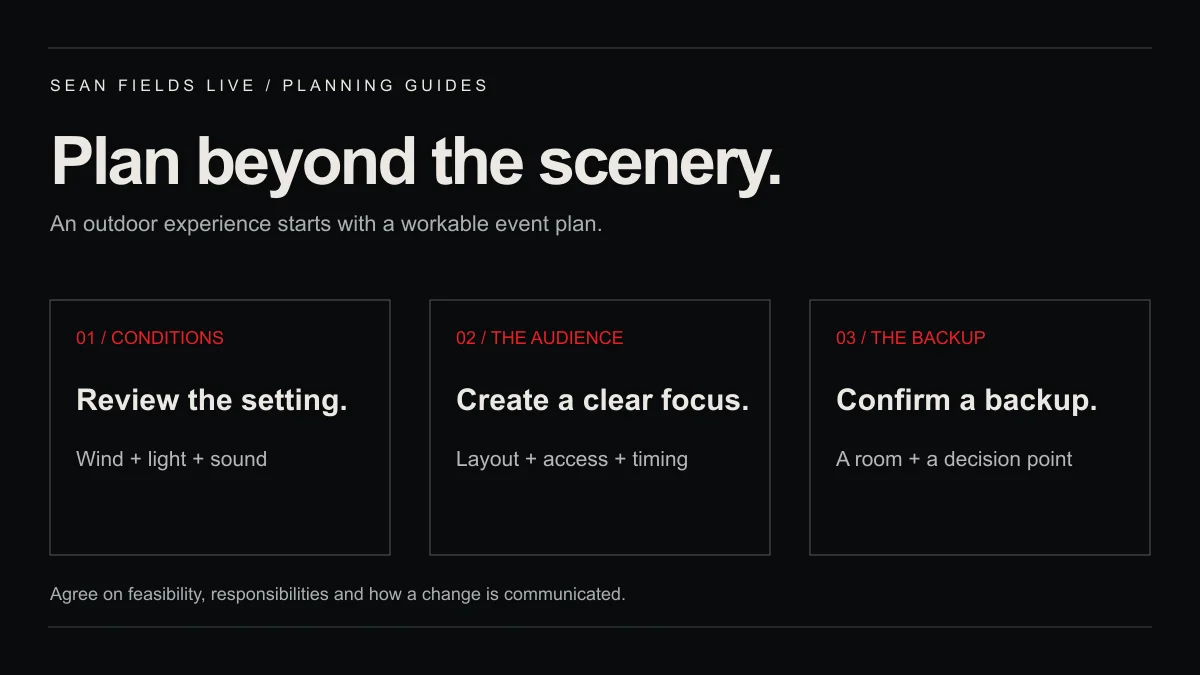
Outdoor magic depends on the specific show, site and conditions. Discuss wind, light, sound, audience layout and a workable backup before confirming the plan. A scenic location or a covered area alone does not establish that a performance will be suitable; the venue and performer need to assess the actual arrangement.
Start with the site and the performance format
A garden reception, a lakeside celebration and a public festival create different conditions for a live performance. Guests may be circulating through a large area or expecting a shared show in a defined space. Explain both the location and what you want the entertainment to do.
When discussing an outdoor event with a Winnipeg-based magician, send the exact venue, attendance estimate, performance window and proposed backup. Sean Fields’ Manitoba booking guidance makes outdoor work conditional on the setting, weather, noise and audience control.
Discuss feasibility before advertising a particular outdoor show. The decision should account for the material, production and guest experience rather than rely on an assumption that an indoor performance can simply move outside.
Review the conditions that affect the experience
| Planning factor | What to describe | What to confirm |
|---|---|---|
| Wind and exposure | The actual location and any proposed shelter | Whether the performance can work in that arrangement |
| Light | Time of day, audience orientation and available lighting | Whether guests can comfortably see the show |
| Sound | Music, traffic, nearby activities and the proposed system | How the audience will hear and who operates equipment |
| Audience area | Seating or standing plan, entrances and guest movement | How the performance area and access routes will be managed |
| Backup | A specific alternate space and its availability | Who decides on a move, when and how it happens |
These are questions for the event team. Follow venue and qualified production guidance for safety, structures and equipment; a performance-planning checklist does not replace those responsibilities.
Create a place where guests can follow the show
An outdoor gathering may spread across several social areas. A featured performance needs a clear focal point, while close-up interaction needs groups that can gather without obstructing access or service.
Describe where guests will stand or sit, what else will be happening and who controls announcements. A performance competing with amplified music, a sports activity or constant movement may need a different location or time.
The show-format guide explains the difference between small-group interaction and a shared feature. The venue requirements checklist helps identify the room and production information needed for an indoor alternative.
Make the indoor backup a real event plan
“We can go inside” leaves important questions open. Confirm the actual room, when it is available, who can authorize its use and whether the guests and agreed show can fit there.
Review seating, sound, access and service for the backup just as you would for the original plan. A private dining room and a large outdoor audience may require a substantial change in format or scope.
A useful hypothetical brief might say: “We are considering a reception outside, with a booked indoor room available during the same period. Please assess which format could work in each space.” Add the actual venue details and avoid promising the same arrangement in both until it is agreed.
Agree on the decision process before event day
Identify the organizer, venue and performer contacts who will review conditions and communicate any change. Confirm a decision point that leaves the team enough time for the agreed alternate setup rather than waiting until guests are expecting the show to begin.
Use Environment and Climate Change Canada’s weather information for current forecasts and alerts for the event location. The team must still assess the site and follow the relevant safety and operational guidance; a forecast is not a guarantee of performance suitability.
Ask how a location, time or format change would be handled under the proposal. A backup plan should include practical responsibilities and the agreed terms, not only a room name.
Brief the actual Manitoba destination
A destination gathering can involve both travel and an outdoor concept. For an Interlake event, for example, the Gimli service page discusses wind, changing light and the need to review a sheltered performance area and indoor backup.
Include the precise property, community and performance location, especially when the venue address does not identify the outdoor area. If guests will move indoors for dinner, explain whether that move could also provide a more workable shared-show slot.
The Manitoba travel-planning guide covers arrival, access and transportation considerations. Outdoor production and travel should be assessed together.
What to send with an outdoor inquiry
- Date, precise location and proposed performance window.
- Audience estimate and seated, standing or circulating arrangement.
- Photos or a plan of the intended performance area.
- Nearby sound, service and other scheduled activities.
- Available production and the venue’s event contact.
- The confirmed alternate space and who can approve a change.
Give the performer a realistic picture of both plans. That makes it easier to decide whether an outdoor concept, an indoor show or a different format is the right fit.
A few more useful answers.
Does a tent automatically make an outdoor show suitable?
No. The venue and performer still need to assess the actual conditions, audience arrangement, production and backup. Follow qualified guidance for the structure and equipment.
Can the show simply move indoors at the last minute?
Only a workable agreed plan can establish that. Confirm the room, access, layout, equipment and decision process beforehand, including any effect on format or scope.
Who decides whether the outdoor plan goes ahead?
Agree on the communication and decision process with the organizer, venue and performer. Safety and operational responsibilities should remain clear, and relevant venue guidance must be followed.
Can an outdoor reception be followed by an indoor show?
It can be discussed as a possible event sequence. Share both locations, timing and production arrangements so the performer can assess the actual plan.

Sean Fields
Sean Fields is a Winnipeg-born magician, mentalist, magic creator and consultant with more than two decades of experience. His work spans close-up magic, corporate stages and creative consulting for television productions. These guides help organizers plan the setting, timing and guest experience for live entertainment.
More about Sean Fields